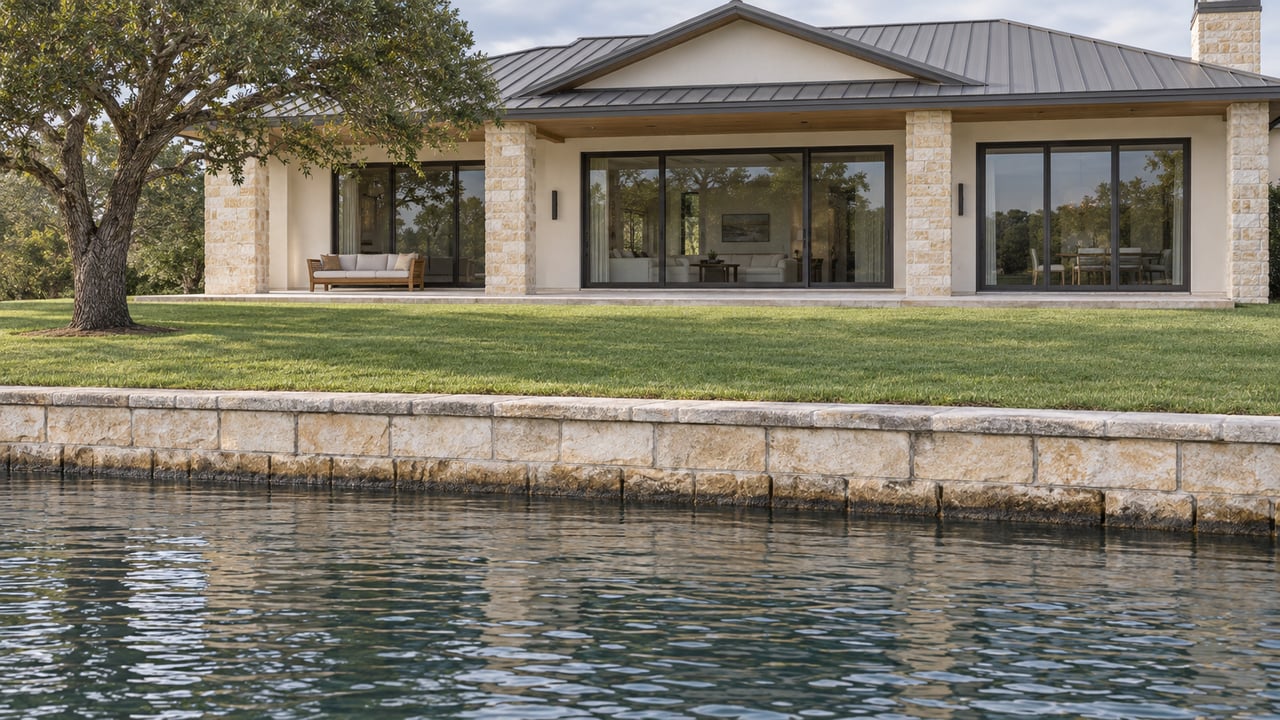
Two waterfront listings come up in the same season. Similar square footage, similar bedroom count, similar age. One closes for hundreds of thousands more than the other. Buyers who found this out the hard way usually assumed the extra money bought a better kitchen or a newer roof. It didn't. Local brokers on Lake LBJ see this gap often enough that it barely raises an eyebrow anymore, and the explanation has nothing to do with the house itself. It has to do with what's attached to it: the shoreline, the depth of the water at the dock, and the condition of the wall holding the two apart.
If you're comparing Lake LBJ to other Highland Lakes properties, or comparing one Lake LBJ subdivision to another, this is the fact that changes how you read a listing. The median price you saw on a search site is a starting point, not a map.
The Water Is the Product, the House Is the Improvement
Lake LBJ is a pass-through reservoir managed by the Lower Colorado River Authority. Water flows in from Lake Buchanan and Inks Lake upstream and has to move out through Wirtz Dam near Horseshoe Bay, which means the lake has no real storage capacity of its own. The practical result is a water level that typically moves only zero to two feet a year, compared to a storage reservoir like Lake Travis, which can drop fifty feet or more during drought and leave docks stranded on dry ground.
That stability is why waterfront on Lake LBJ prices the way it does. Buyers aren't just purchasing square footage. They're purchasing a shoreline asset that behaves the same way every season, and the value of that asset is set by a short list of physical facts that have nothing to do with the floor plan:
| Waterfront input | What it changes | Rough price effect |
|---|---|---|
| Linear waterfront feet | Under 60 feet feels tight, 80 to 100 feet is considered the workable sweet spot, 150 feet or more moves into estate territory | Largest single driver of price, especially on the open lake |
| Water depth at the dock | Deep water supports a wake boat or cruiser, shallow water limits you to a pontoon or jet ski | Can swing value more than an extra bedroom |
| Bulkhead condition | A failing bulkhead runs $40,000 to $150,000 to replace, and a new install can run $50,000 to $200,000 or more | Directly subtracted from or added to negotiated price |
| Boathouse and permit status | A covered, permitted structure with a transferable LCRA permit adds real value, an unpermitted ramp doesn't | Confirmed at closing, not assumed from photos |
| Orientation | South and east-facing shoreline gets morning light and afternoon shade, which matters through a Texas summer | Smaller effect but noticeable in comparable listings |
None of these show up cleanly in a listing's headline price. They show up in the option period, when a buyer's agent pulls soundings, checks the LCRA permit history, and has someone look at the bulkhead. That's also where the $800,000 gap between two similar houses usually gets explained after the fact.
Why the Price Tag Rarely Lines Up With Square Footage
Ask a Lake LBJ broker for a price-per-square-foot number and most will give you one, then immediately tell you not to lean on it. Recent multiple listing service data puts the median somewhere in the mid to high six hundreds per square foot for waterfront homes, with listings ranging from entry-level properties near $200,000 up to flagship estates well past $10 million. That spread is the tell. On an inland subdivision, price per square foot is a reasonably reliable way to compare two houses. On the lake, it's closer to a rounding error next to the waterfront itself.
Part of the reason is the split between main-body and canal properties. Main-body homes sit on the open sections of the lake between Kingsland and Horseshoe Bay, with big views and wake-boat traffic that runs most of the year. Canal homes sit on protected, man-made channels with deeper water at the dock, quieter conditions, and easier low-speed docking. Two homes with the same square footage on these two settings are not comparable products. One buyer is paying for view and lake noise, the other is paying for depth and quiet, and the market prices those differently even when the tax appraisal treats them the same.
Neighborhood tier compounds it further. The same 80 feet of shoreline commands a different price in Applehead Island than it does in a more accessible community like Granite Shoals, largely because of POA rules, gated access, and the reputation the community has built over years of resale activity.
The Line an Appraisal Won't Draw for You
If rental income is part of the plan, the most important line on Lake LBJ isn't on a map. It's the boundary of a homeowners association, and it can cut through what looks from the road like a single, uniform stretch of waterfront.
Some communities around Lake LBJ include:
- Kingsland is largely unincorporated
- Escondido, a roughly 550-acre gated community built around a Tom Fazio golf course
- Applehead Island, one of the more limited-inventory, guard-gated enclaves on the lake
Two properties can sit less than a mile apart, carry nearly identical waterfront footage, and have completely different income potential once you account for which side of an HOA boundary they fall on. A buyer running the numbers on a rental property needs the deed restrictions and the current HOA rule book before writing an offer, not after closing. The title commitment and the recorded governing documents are the places to confirm what the property allows.
The same logic applies to gated golf communities built for full-time or seasonal living rather than income. The Legends on Lake LBJ, a gated community on the Colorado Arm built around a Tom Kite-designed course, and The Trails of Horseshoe Bay, a gated equestrian community with its own private marina, both draw buyers who have no interest in renting the property out. Blue Lake Estates, on the south shore with its own private lake park and golf course, fits a similar profile. None of that is a judgment on the communities. It's simply a reminder that the lake isn't one market with one set of rules. It's a series of smaller markets stitched together by a shared shoreline.
The Reason Any of This Holds Together
Every input above, the frontage math, the bulkhead economics, the rental variance, only works because the lake itself doesn't move much. On a storage reservoir, a bulkhead can be submerged one year and standing in dry dirt the next, which makes long-term dock investment a gamble tied to rainfall. On a pass-through lake with a narrow annual swing, a buyer can look at a dock in January and reasonably expect it to look the same in August. That predictability is what allows lenders to view these properties more favorably and what allows the waterfront-specific pricing inputs to actually function as pricing inputs, rather than being overridden every few years by drought.
It's also why LCRA permitting matters more here than it might elsewhere. Every dock, boathouse, and bulkhead on the lake requires a permit, and the transferability of that permit at closing is one of the few details that can quietly reduce or eliminate a buyer's ability to use the water the way the previous owner did. The LCRA's own guidance on docks and marinas is public and worth reading directly if you're this far into a purchase.
A few questions that come up often
Does price per square foot mean anything when comparing Lake LBJ listings? It's useful as a rough sanity check but not as a comparison tool between two waterfront properties. Waterfrontage, depth, and bulkhead condition move the price far more than an extra few hundred square feet of house.
Are LCRA dock and bulkhead permits automatically transferred when a property sells? No. Permit status should be confirmed and verified as current and transferable before closing, since some structures carry permits that have lapsed or were never obtained.
Can I assume every waterfront home on the lake can be used as a short-term rental? No. Permission is set at the city, county, or HOA level and varies by specific community and sometimes by subdivision within a community. Verify the deed restrictions and current rules for the exact property before rental income becomes part of your plan.
If you're weighing waterfront footage against a floor plan, or trying to figure out whether a subdivision's rules will support the plan you have in mind, that's the exact conversation Kale Stephens has with buyers on this lake every week. Reach out before you write the offer, not after.
This article is general information, not legal, tax or financial advice. Consult a qualified professional about your situation.